Starting points
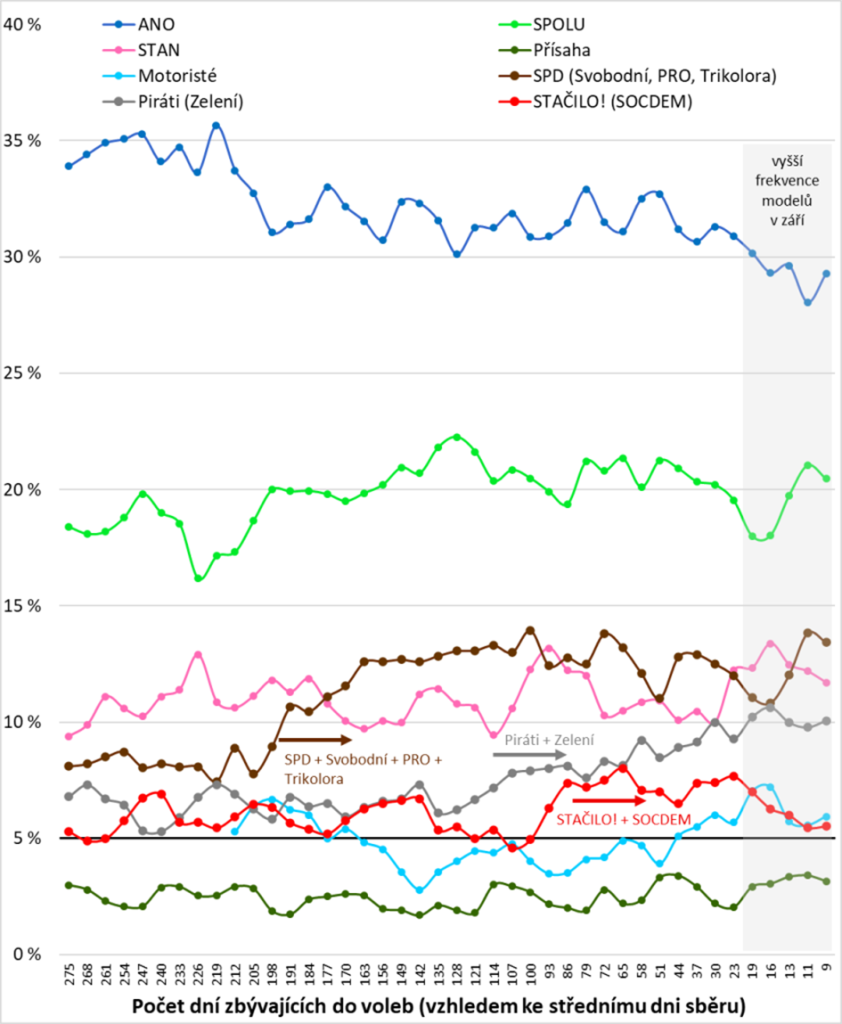
The strongest motive in this election year is the consolidation of political forces. The lessons learned from previous elections were exceptionally powerful, and for many politicians, parties, and movements, the need to join forces prevailed over the need to promote their own ideas about state administration. In the first half of this year, we saw a major alliance between the Free Party, PRO, and Trikolora with the SPD movement, which is playing a dominant role in leading them into the elections on its candidate lists. The Greens and the Pirates also formed a similar alliance. For both groups, this alliance has led to an increase in popularity beyond the simple sum of their previous gains. In the case of the SPD, this meant regaining the strongest voice among protest-minded voters, as they managed to gain the upper hand over the STAČILO! movement on the one hand, and on the other hand, their strengthening led to a reduction in the high gains of the ANO movement from the beginning of the year. In the case of the Pirates and the Greens, it was one of the components of a renewed growth in support, which has now led them to a symbolic battle for a stronger position with the STAN movement, their coalition partner from the previous parliamentary elections.
There has also been speculation for some time about an alliance between SOCDEM and STAČILO! and between the Přísaha movement and Motoristé sobě. In the latter case, the negotiations were unsuccessful. An alliance between the STAČILO! movement and SOCDEM was finally reached at the last minute. For now, however, their story is different from the first two mentioned, as their combined support has not yet matched the separate total from the first half of this year.
Another distinctive feature of Czech politics is the formation of voters into two relatively solid blocs, depending on which parties these voters choose. On the one hand, there are the parties of the governing coalition and the Pirates and Greens, which appeal to slightly more than two-fifths of voters. On the other side is the ANO movement, accompanied by the SPD, STAČILO!, Přísaha, and Motoristé sobě parties, which together appeal to over half of voters. Typically, voters primarily consider parties on one side or the other of the spectrum. Transitions or shifts between blocs are rare. It is important to note that we could already see these blocs of voters/political forces forming in 2021.
Although the ANO movement has lost a significant amount of support since the beginning of the year, it remains the dominant force on the Czech political scene. A scenario in which the ANO movement would not win the highest number of votes and the most seats is almost impossible. Only slightly more likely is that it would be possible to form a government without ANO’s participation after the elections. However, much will depend, of course, on the negotiating position in which the ANO movement ultimately finds itself after the election results are announced and what government options will be offered to it.
Among Czech voters, we have long observed that just under a fifth express dissatisfaction with the current direction of the country and a marked distrust of the existing system. Historically, of course, the range of parties and movements that appeal to such voters has changed, with the SPD and STAČILO! movements currently making no secret of their dissatisfaction with the Czech Republic’s international positioning and direction, or with the functioning of certain domestic institutions.
As usual, various scandals associated with individual political forces play a certain role. No significant changes in public sentiment can be expected from the new findings in the Čapí hnízdo case. On the contrary, new findings in the Dozimetr case, especially given that they came to light very shortly before the elections, may influence the election results. However, these new facts are largely not reflected in the models. It usually takes several days or weeks for a case to become widely known and for the public to form an opinion about it. We saw this in the case of the bitcoin scandal involving former minister Pavel Blažek, when its impact on the results of the SPOLU coalition only became apparent after a delay of about three weeks. We can also say that this scandal did not cause a significant drop in preferences for the SPOLU coalition, but it did significantly slow down their potential for further growth. The scandals surrounding SPD chairman Tomio Okamura may have served as an additional mobilizing impulse for some voters who are very skeptical of the current system, rather than limiting their gains in any way.
The role of the last month
As usual, the last month before the elections brings greater electoral momentum, both in terms of pre-election events and the results of pre-election polls. In addition to the large parties and movements, which can afford to run virtually permanent campaigns, smaller groups have also joined in during the last month and significantly strengthened their presence in the public sphere, including larger campaigns on flyers and billboards.
In addition to campaigns, politics is appearing more frequently in the media and public debate. Pre-election debates are taking place, a lot of attention is being paid to new scandals and findings, the media are paying increased attention to politics, election campaign materials with program points and ballots are appearing in the mailboxes of all citizens, and space is reserved for all candidates in the public media.
People, including those who do not normally take much interest in public affairs, are thus much more likely to come into contact with the electoral offer. Politics also becomes a more frequent topic of discussion in families, among friends, and in the workplace. Surveys show that the combined effect of the last month before the election is reflected in growing interest in the elections and, this year, also in a gradual increase in potential voter turnout. More people than in the inter-election period report that they are planning to vote. The proportion of those who are undecided about their participation has also been steadily declining over the last month. However, there are still plenty of undecided voters in September, although most of them are now choosing between the few remaining parties.
The STEM model shows three main trends in September:
One is an increase in participation, which is largely made up of people who were hesitant about whether to vote for any of the governing parties or the Pirates and Greens. To a certain extent, they are thus offsetting the previously increased participation of the other voter bloc.
Another movement is the increased dynamics in the camp of the former five-party coalition, where there is a strong group of voters who are considering voting for all three parties but have not yet made a final choice. The least certain result now seems to be that of STAN, which has the potential to gain a lot but also has a lot to lose.
The latest movement is taking place in the second camp, where the ANO movement continues to weaken slightly, but it is not clear whether such voters will return to ANO or ultimately lean toward someone else. So far, our model has shown that the SPD movement has strengthened, while STAČILO! has weakened. The development of Motoristé sobě is unstable, and they find themselves in a situation similar to that of the STAN movement.
For us as researchers, it is also important to reiterate the limitations that surveys and pre-election models naturally entail. From an analytical point of view, an election gain of plus or minus 2 percentage points essentially means no change. However, we realize that even differences of tenths of a percent can mean a different situation for post-election negotiations in actual elections. Nevertheless, surveys do not allow for such precision. Another extremely important context is that a pre-election model is always relevant to the time when the data was collected. It is not a prediction of how the elections will turn out, but rather a snapshot of the electoral mood at a given time. Even the most recent models describe the situation at least a week before the elections. And the last week can still mean a lot for the outcome of the elections themselves.
Detailed development of the weekly STEM election model for the main parties participating in the elections (since the beginning of 2025)
What to expect in the final week
In the final week, other factors come into play alongside the campaigns themselves. Pre-election debates, especially attractive duels shortly before the election, can have an impact. However, it is usually not important what topics the party representatives discuss, but rather what impression the debate and the candidates’ performance make on the public.
Debates can also reinforce one of the most common electoral phenomena, whereby some undecided voters ultimately lean towards the leader who comes across as the most convincing frontrunner or main challenger. This appears to have happened in 2021 in the final stages between the SPOLU and PirSTAN coalitions, when the impression among very undecided voters favored the SPOLU coalition and Petr Fiala at the last minute.
There is speculation as to whether, shortly before the elections, there will be some last-minute “below-the-belt” news aimed at discrediting a candidate or entity without giving them time to respond adequately. We saw such tactics in both rounds of the presidential election in which Miloš Zeman was a candidate. In the case of parliamentary elections, however, such a tactic may not be as effective.
A major unknown was the new feature of the electoral system – postal voting from abroad. However, given the number of registered voters and the current number of foreign voters, we can say that the influence of votes from abroad will be marginal. The expected number of votes from abroad is 30,000 to 40,000, which will be less than one percent of the total votes, divided among four regions.
We can ultimately expect voter turnout to be comparable to that achieved in October 2021. Overall, we can also expect the ANO movement to win the election. The question then is whether a government other than one led by this movement will be able to form. However, it remains a relatively big question as to how stable and clear-cut a government can be formed. The role of the president may also be interesting, both in terms of commissioning the formation of a government and appointing ministers.
The most interesting and, from the point of view of the post-election constellation, key thing to watch will be the fate of the parties hovering around the five percent threshold required to enter the Chamber of Deputies. The Přísaha movement is very unlikely to exceed its previous result and will not come close to this threshold again. On the contrary, the numbers for the STAČILO! and Motoristé sobě movements now suggest that both groups should make it into the Chamber of Deputies. For STAČILO!, the final decision will be made by how protest voters choose between them and the SPD. For Motoristé sobě, the turnout of their voters, who are usually among the less disciplined, will be key.
The selection of respondents was always representative of the adult population of Czechia and was carried out using a quota method in terms of gender, age, education, region, and size of place of residence. We also pay attention to ensuring that the sample reflects the results of the last parliamentary elections in 2021, and we take into account social and occupational status, past voting behavior in the 2021 parliamentary elections, and in the second round of the 2023 presidential elections. Online data collection (CAWI) of respondents registered in the Czech National Panel is provided by the STEM/MARK agency, which, like STEM and the Czech National Panel, is a member of the SIMAR professional organization and proceeds in accordance with its standards when implementing projects.
The models in the series were always based on the responses of more than 1,200 respondents surveyed over three consecutive weeks. In the latest models, the frequency of data collection was higher, making the data more relevant to the elections themselves. To ensure the highest quality results, we verify the attention of respondents, the logical connection between answers to individual questions, and we also exclude questionnaires that were completed suspiciously quickly. The statistical error of the sample is around ± 1.0 percentage point for the smallest parties and around ± 3.0 percentage points for larger parties.
The models presented are part of the unique Weekly Model research series, which STEM compiles for CNN Prima News. We describe the methodology of this research in detail on our website:https://www.stem.cz/?metodologie=tydenni-model-pro-cnn-prima-news-2025