Several months after the elections and prior to the vote of confidence in the government in the Chamber of Deputies, STEM, on behalf of CNN Prima News, investigated the level of public trust in the highest constitutional officials. According to the survey at the beginning of 2026, President Petr Pavel has the confidence of nearly three-fifths of citizens (57%). More than half of the people (55%) trust Prime Minister Andrej Babiš, while nearly two-fifths of citizens trust the Speaker of the Chamber of Deputies, T. Okamura. The same proportion of people have confidence in Senate President M. Vystrčil. However, in the case of Tomio Okamura, there are significantly more people who definitely do not trust him compared to Miloš Vystrčil. Less than a third of citizens express confidence in former Prime Minister Petr Fiala
If we look at a general comparison of trust in constitutional officials with a survey conducted at a similar timespan from the previous Chamber of Deputies elections in 2021, we observe a clearly higher level of trust in the President – President Miloš Zeman had the confidence of 29% of citizens in January 2022. In the case of the Prime Minister, Andrej Babiš also currently enjoys a higher level of trust than Petr Fiala did in January 2022 (38%). Senate President Miloš Vystrčil currently has a similar level of trust as in 2022 (38%). Speaker of the Chamber of Deputies Tomio Okamura has a slightly higher share of those who trust him than the then-Speaker Markéta Pekarová Adamová (31%).
“Do you have confidence in (…)?”
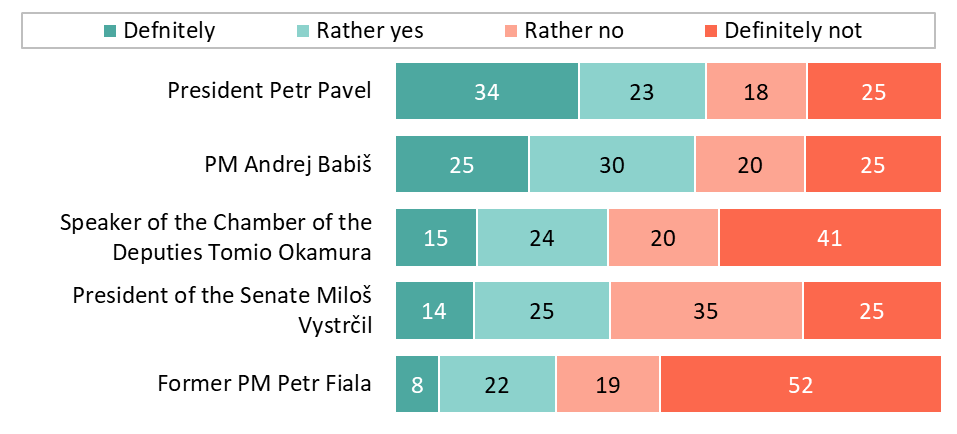
Source: STEM for CNN Prima News, January 2026, N = 1089, CAWI
As expected, the level of trust in constitutional officials is strongly conditioned by political preferences. We observe majority trust in Prime Minister Andrej Babiš among voters of ANO, SPD, STAČILO!, and to a lesser extent among Motorists voters. Speaker of the Chamber Tomio Okamura is trusted mainly by voters of his movement; among ANO movement voters the level of trust is lower, though still a majority, which is no longer true for voters of Motorists. Voters of SPOLU, STAN, and Pirates quite clearly trust President Petr Pavel. The level of trust in Senate President Miloš Vystrčil is also a majority, albeit lower, primarily among Pirate voters.
“Do you have confidence in (…)?” – by vote in the Chamber of Deputies elections in October 2025 (“definitely” + “rather yes”)
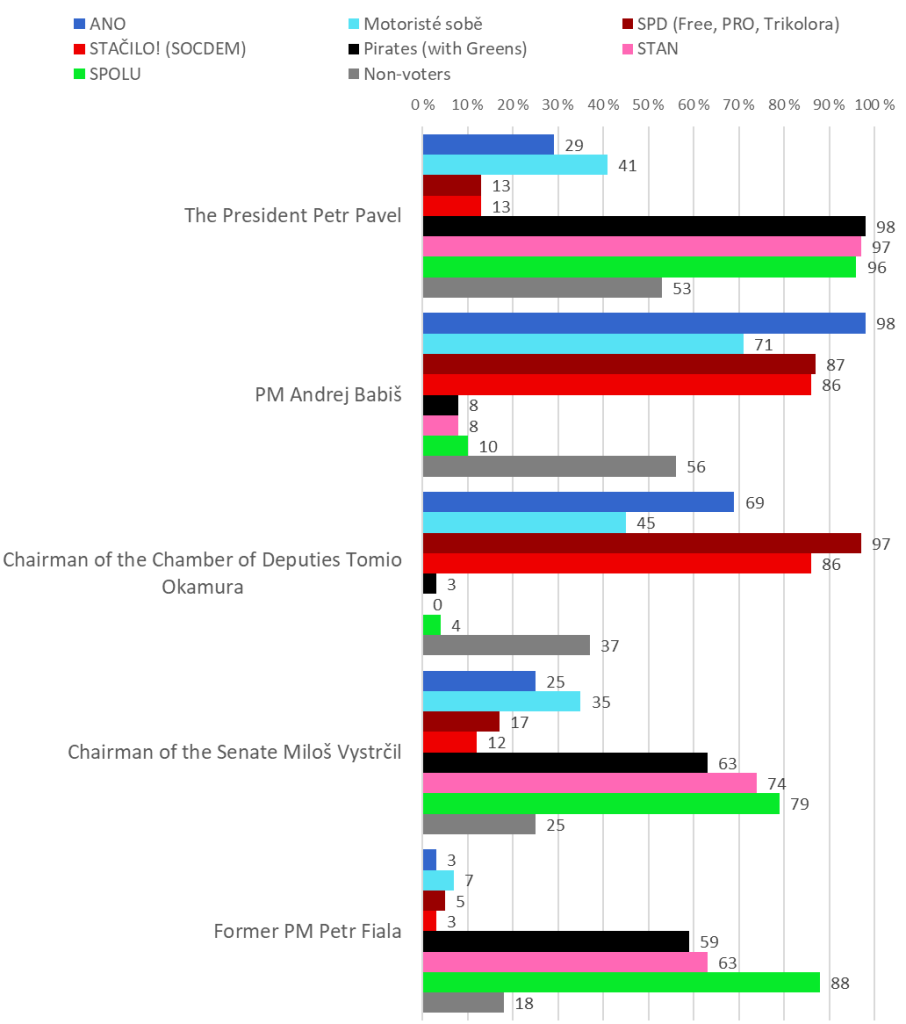
Source: STEM for CNN Prima News, January 2026, N = 1089, CAWI
Following President Petr Pavel’s New Year’s address, a question related to the content of the speech was also included in the survey. The results show that President Petr Pavel has a strong mandate from the public (72%) to guard respect for democracy on the part of the government. This attitude holds an absolute majority among voters of Pirates, STAN, and SPOLU. There is also majority agreement among non-voters and voters of Motoristé sobě, and half of the ANO movement voters also agree. Only voters of SPD and the STAČILO! coalition reject this role of the president in the majority.
“In his New Year’s address, President Petr Pavel stated that he would monitor whether ministers are taking steps that would endanger our democracy or institutions. In your opinion, should the President watch whether the government observes the democratic rules valid in our country?”
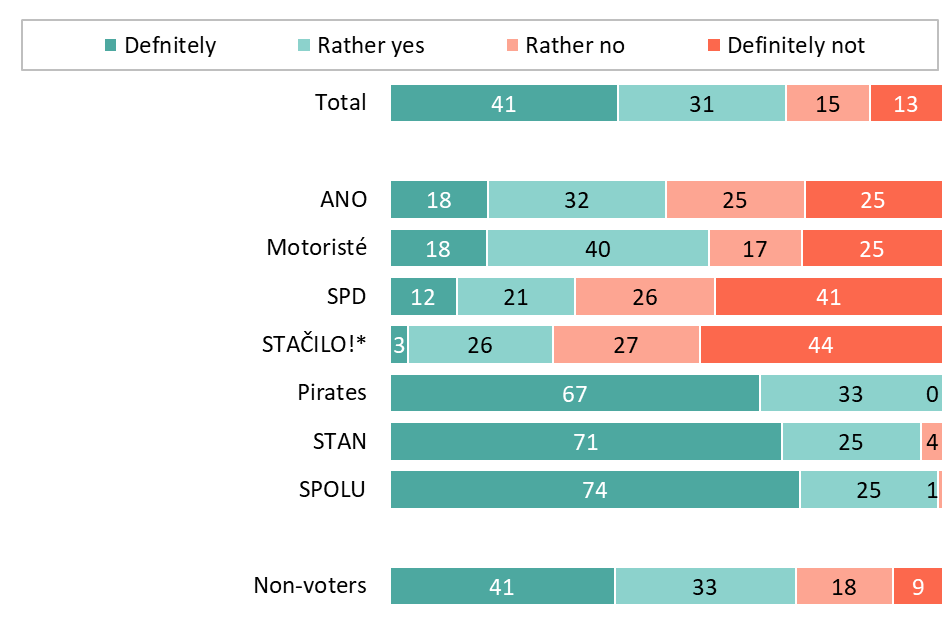
Source: STEM for CNN Prima News, January 2026, N = 1089, CAWI
The data set for the above analysis was created as part of a STEM survey for CNN Prima NEWS. The survey took place from January 2–7, 2026 using the CAWI method on a sample of N = 1,089 persons. The survey is based on a quota selection of respondents representing the Czech adult population (quota criteria: gender, age, education, region, and size of municipality). The representativeness of the file is further strengthened by weighting deviations from the main quota characteristics, as well as weighting for past voting behavior in the elections to the Chamber of Deputies of the Parliament of the Czech Republic in October 2025 and for socio-economic status.