
Trust in institutions is one of the key indicators of the overall social climate, and STEM has been tracking it over the long term in its regular surveys. Trust in individual institutions does not always reflect the performance of the institution itself or people’s personal experiences, but also how these institutions are discussed—whether in the political arena, the media, or among influential public figures. At the same time, different types of institutions play different roles and have varying impacts on the functioning of society, which in turn influences how the public perceives them. This means, for example, that people have different expectations of security or regulatory agencies than they do of international institutions or political representatives. Furthermore, the credibility of institutions does not change abruptly unless there is a significant crisis or a highly unpopular move by a particular institution. It is therefore important to monitor the trends that STEM has been tracking in its surveys since the mid-1990s.
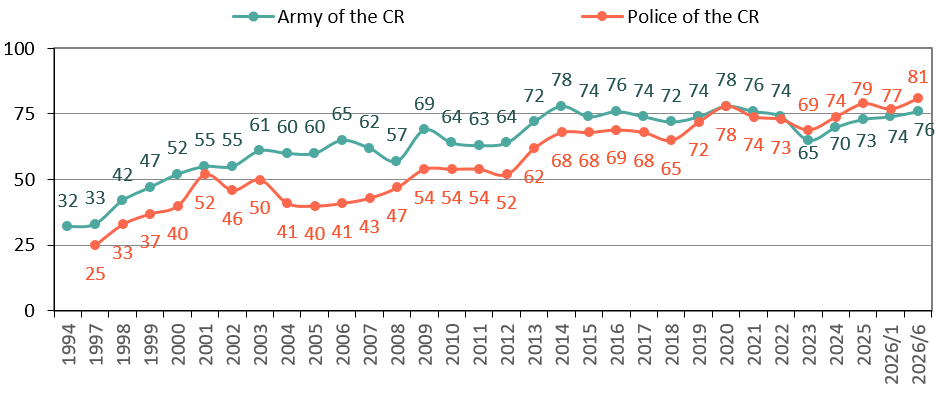
As in previous years, the STEM survey, conducted in the second half of June, shows that nearly everyone (95% of citizens) trusts the Fire Rescue Service, which has long held a completely unique position in this regard. However, other security agencies also enjoy a high level of trust, including the Czech Police (81%), the Czech Army (76%), and the municipal police (71%).
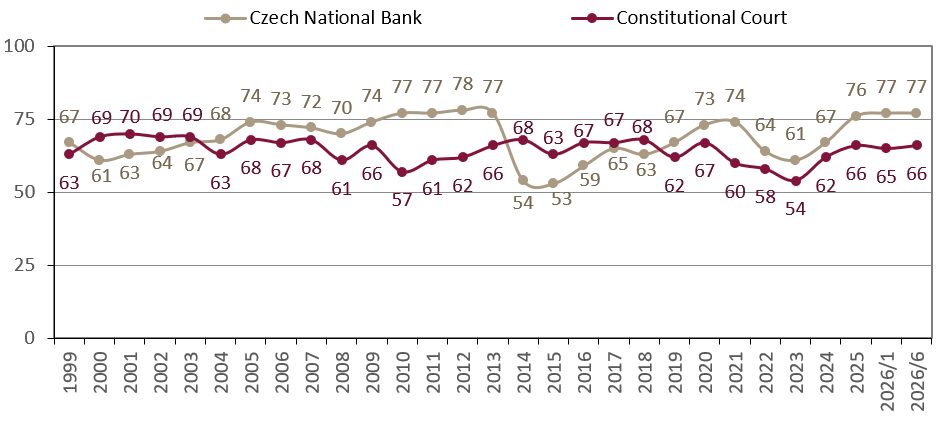
Other institutions with a high percentage of people who trust them include the Czech National Bank (77%); a slightly lower percentage of people trust the Czech Trade Inspection Authority (74%), the Supreme Audit Office (72%), municipal offices (72%), and local self-governement (66%). However, in the case of municipal offices and local self-governement, we are seeing a slight decline in trust, which may be related to the upcoming municipal elections.
Judicial institutions—the Supreme Court (68%), the Ombudsman (66%), and the Constitutional Court (66%)—also enjoy a public approval rating of more than half.
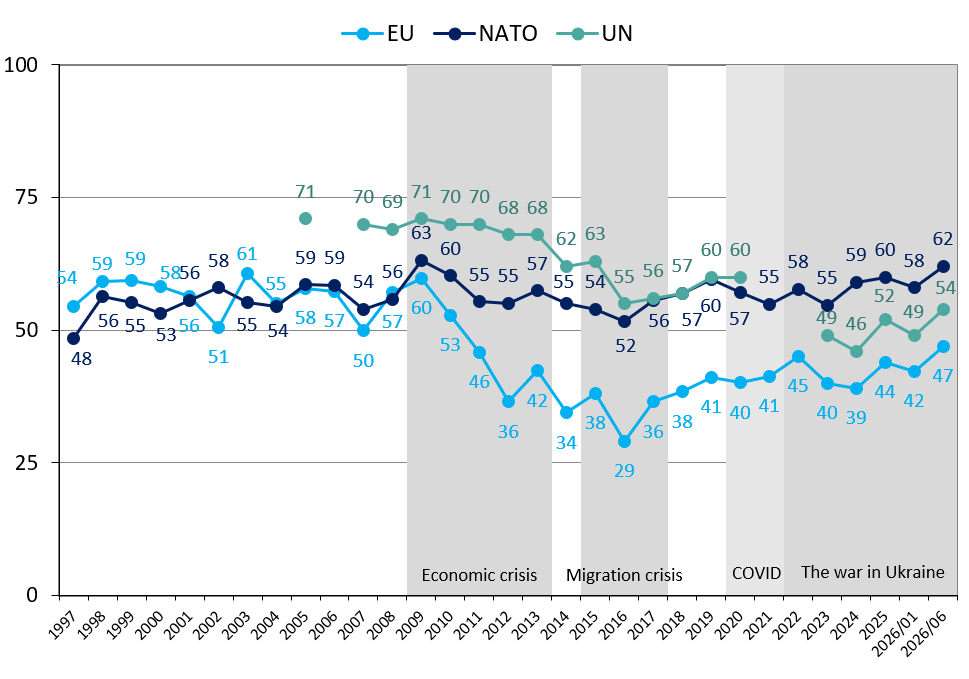
Among international institutions, a majority of citizens trust NATO (62%), the International Monetary Fund (52%), and the United Nations (54%); on the other hand, less than half of the public trusts the European Union (47%).
Among the institutions surveyed, we have long observed the lowest levels of trust in political institutions: the government members (32%), the Chamber of Deputies (35%), and the Senate (43%).
The President of the Republic occupies a different position from the political institutions mentioned above; in June, a majority of citizens (56%) expressed confidence in him. The same proportion of Czechs trusted the president in January 2026 as well. Since Petr Pavel’s election, the president’s approval rating has thus remained above 50%. In addition to unequivocal trust among supporters of SPOLU, STAN, and the Pirates—at around 90%—the president also enjoys the trust of a portion of voters from the current governing coalition (the ANO movement: 29%; Motoristé: 45%, results similar to those of the January poll). Only among SPD voters does the president enjoy the trust of a mere handful of people (10%). For context, the survey was conducted in the second half of June (June 16–21), meaning just before the government announced which participants it planned to send to the NATO summit in Ankara, Turkey. The public was therefore unaware of the government’s decision regarding the president’s non-participation or the Constitutional Court’s preliminary ruling on his participation.
„Do you trust the following institutions?“
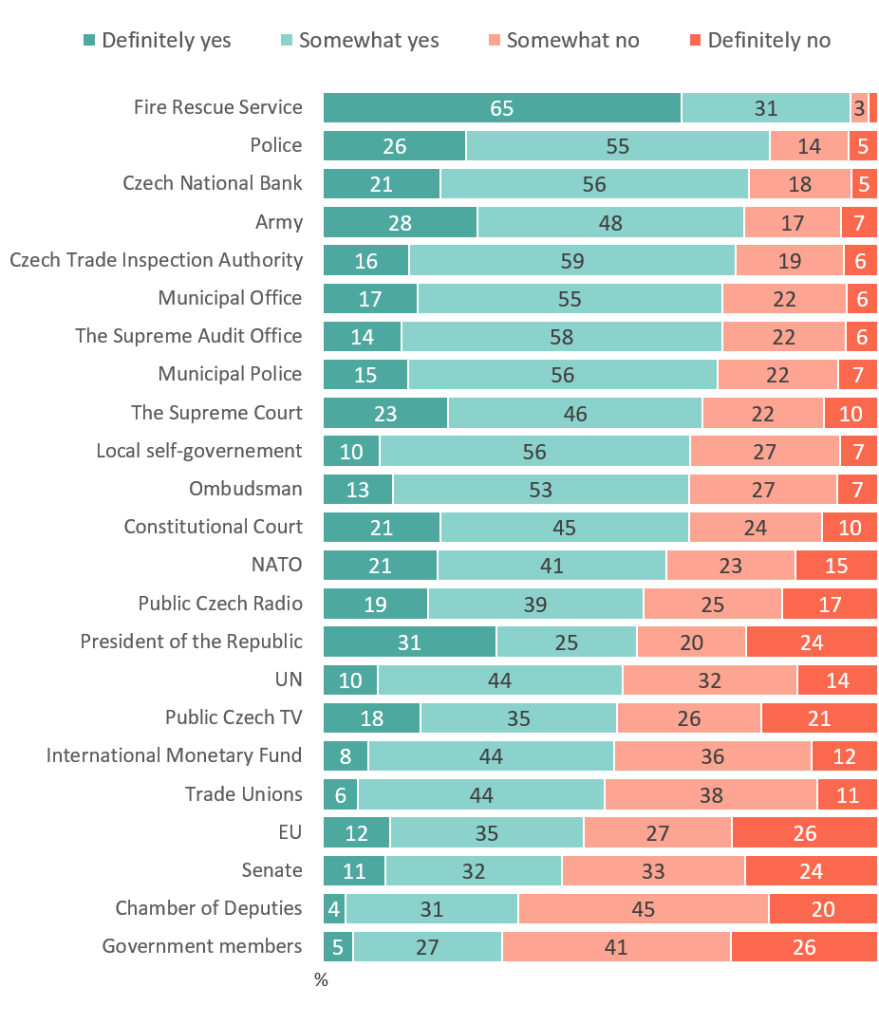
Source: STEM, Trends 6/2026, 1352 respondents
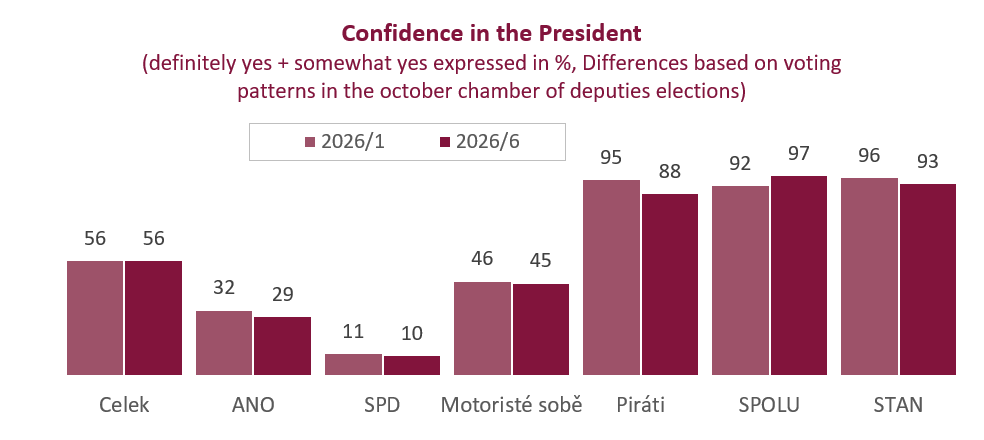
Source: STEM – Trends 1/2026, 6/2026
Note: For smaller political groups, the data are only approximate due to the small number of respondents.
Trust in institutions directly linked to the exercise of political power or lawmaking remains consistently low, although following the elections to the Chamber of Deputies, we observed a slight increase in the proportion of those who trust members of the government or the Chamber of Deputies. “The latest survey confirmed this result, thus sustaining the effect of the change in political representation following last year’s elections to the Chamber of Deputies, when the groups of people who trust the Czech government shifted,” says STEM analyst Jitka Uhrová. In September of last year, supporters of the SPOLU coalition and the STAN movement were clearly more likely to trust the government; since the elections, however, we have observed a significantly higher level of trust in government members among voters of the ANO and SPD movements, and to a lesser extent among Motoristé. Trust in the Senate has been strengthening slightly in recent years.
„Do you trust the following institutions?“ – political institutions (definitely yes + somewhat yes expressed in %)
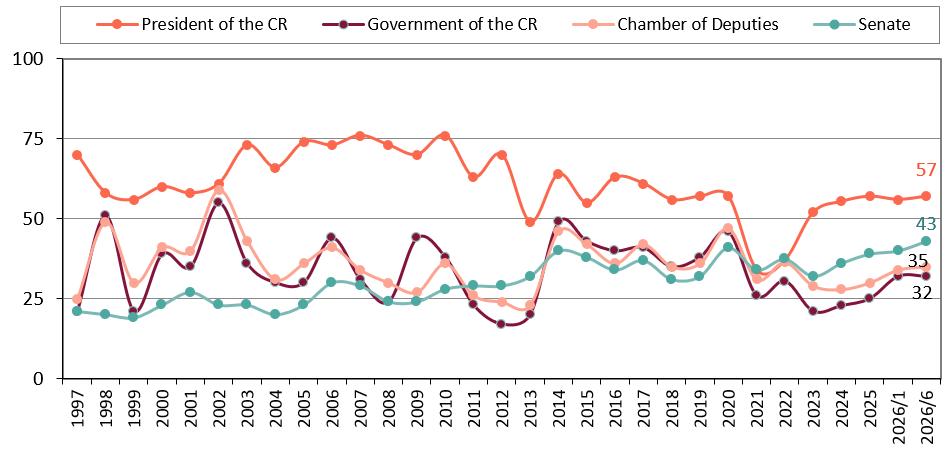
Source: STEM – Trends 1997-2026
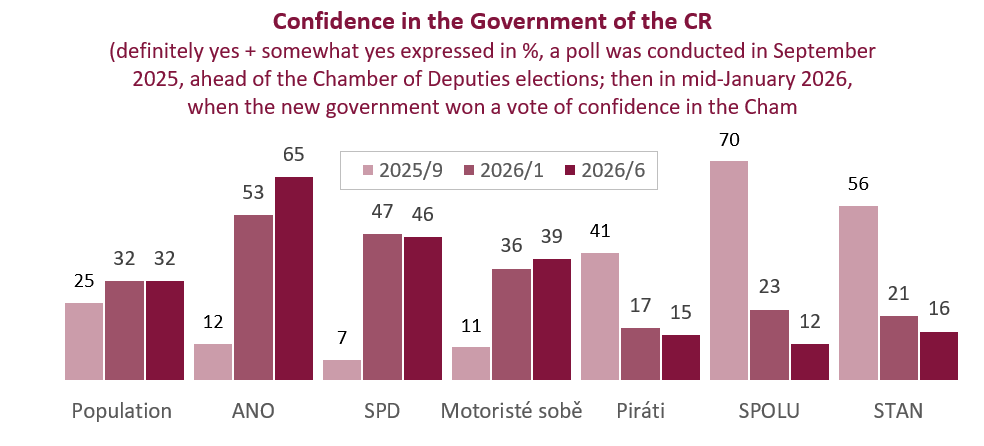
Source: STEM – Trends 09/2025, 1/2026, 6/2026
Note: For smaller political groups, the data are only approximate due to the small number of respondents.
Security forces have long been among the most trusted institutions in Czech society. The level of trust in the Czech Police and the Czech Army has remained stable at around 70% over the past 10 years. In the latest survey, we observe a return of a high proportion of respondents who trust the Czech Police to a level that represents an all-time high in STEM surveys since 1994. Trust in the Czech Army remains consistently high, though it has strengthened only slightly. Furthermore, attitudes toward various institutions are, to a certain extent, influenced by political preferences. For the Army, this means strong confidence from supporters of the SPOLU coalition, the STAN movement, and Pirates, at around 90%; conversely, the proportion of those who trust it is significantly lower among SPD voters (52%). Among voters for the ANO movement (73%) or the Motoristé (80%), those who trust the Czech Army already constitute a clear majority. In the case of the Czech Police, the only difference is among SPD voters (with support from Svobodní, PRO, and Trikolora), 65% of whom trust the Czech Police, while among other voters, the figure is over 80%.
„Do you trust the following institutions?“ – Army and Police of the CR (definitely yes + somewhat yes expressed in %)
Source: STEM – Trends 1994-2026
In recent years, the Czech National Bank has consistently ranked among the institutions with the highest levels of public trust. The central bank regained its credibility following a decline linked to the economic crisis and high inflation in 2022–2023 and now enjoys the trust of a three-quarters majority of the public across the political spectrum. By comparison, the Constitutional Court’s credibility is slightly lower, at two-thirds of the public, and is significantly politically driven: on one end of the spectrum, only 21% of SPD voters (with support from the Svobodní, PRO, and Trikolora) trust the Constitutional Court, while on the other end, as many as 91% of voters from the SPOLU coalition do. Let us reiterate that the survey was conducted before the Constitutional Court issued its preliminary injunction regarding Petr Pavel’s participation in the NATO summit.
„Do you trust the following institutions?“ – Czech National Bank and Constitutional Court
(definitely yes + somewhat yes expressed in %)
Source: STEM – Trends 1999-2026
Trust in international institutions is relatively stable. Currently, three-fifths of Czechs trust NATO, more than half trust the United Nations, and nearly half trust the European Union. From a long-term perspective, the level of trust in NATO has remained relatively stable, while the European Union has faced a more significant decline in trust, primarily in connection with the economic and migration crises.
„Do you trust the following institutions?“ – EU, NATO and UN (definitely yes + somewhat yes expressed in %)
Source: STEM – Trends 1997-2026
The cited research by the STEM Institute (www.stem.cz) was conducted on a representative sample of Czech residents aged 18 and over between June 16 and 21, 2026. Data collection was conducted using a quota sampling method via an online survey (CAWI) as part of the regular “Trends” research series. A total of 1,352 respondents answered the questions. Data from other surveys in the Trends series, carried out using the same methodology on samples of approximately 1,000 respondents, are also used.