
The general unemployment rate reached 2.8% in the Czech Republic in April 2024, the same as in April of the previous year[1]. At the end of April 2024, the number of jobseekers registered with the Labour Offices was just under 280,000. Although the number of registered unemployed people decreased by more than 15,000 compared to January 2024, the number of registered unemployed in April this year is 18,000 higher than in April 2023[2]. Despite the slight increase in these figures, the unemployment rate and the number of unemployed people are still at low levels compared to historical trends.
How have the worries of working-age Czechs regarding unemployment developed in this situation? According to the results of the May STEM Research Institute survey, 39% of the Czech public are worried about unemployment, with just under half of them expressing strong concerns. The attitudes of the Czech population towards unemployment are very much in line with current socio-economic developments at the national and global levels. Thus, pessimistic scenarios regarding labour market developments still resonate among people in the Czech Republic. Still, the level of concern recorded in May 2024 is at one of the lowest levels in historical comparison. However, this result should by no means lead to abandoning efforts to reduce unemployment.
“Are you personally concerned about unemployment?” (in %)
(Population excluding old-age pensioners)

Source: STEM – Trendy (“Trends” regular survey) 05/2024 (N = 733)
“Are you personally concerned about unemployment?” (in %)
(the sum of “Definitely” and “Somewhat”)
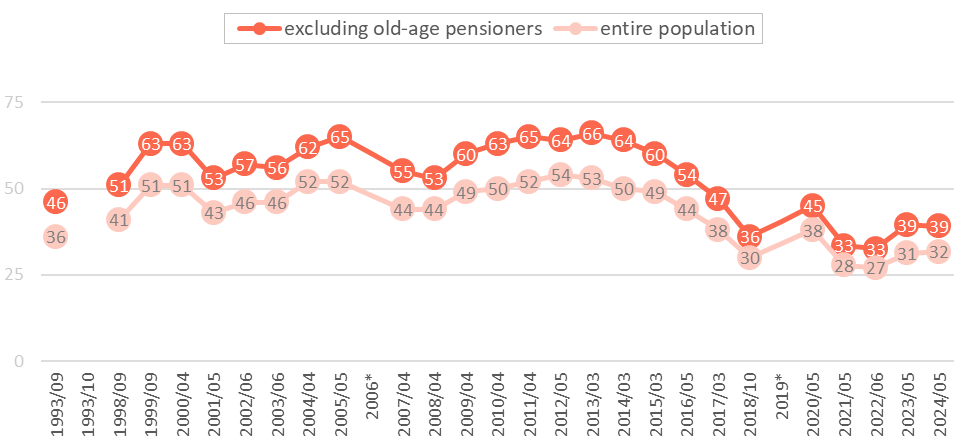
* The question was not included in the marked year.
Source: STEM, Trendy 1993-2024
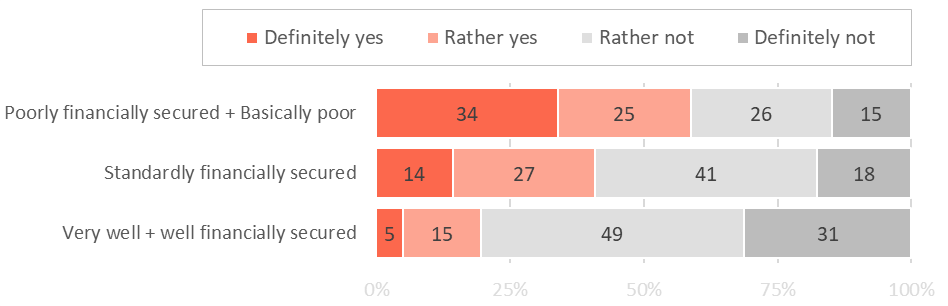
Unemployment is much more often a matter of concern for people who, in their subjective opinion, are poorly financially secure or basically poor. In the least well-off group, 59% of people are concerned about unemployment, while in the best-off group, 20% expressed concern.
“Are you personally concerned about unemployment?” (in %)
(Population excluding old-age pensioners)
Source: STEM – Trendy 05/2024
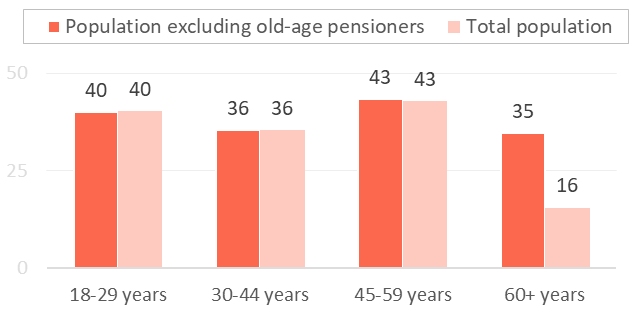
The results of the May 2024 Trendy (“Trends”) survey by STEM Research Institute also show that people of pre-retirement age are more often worried about unemployment. In the 45–59 year-old group, 43% of people expressed concern about unemployment, which was three percentage points more than in the youngest age group (18-to-29-year-olds) and eight percentage points more than in the oldest age group (60+ year-olds). The figure clearly shows that concern about unemployment declines sharply as people enter retirement and start receiving pensions.
„Obáváte se Vy osobně nezaměstnanosti?“
Source: STEM – Trendy 05/2024
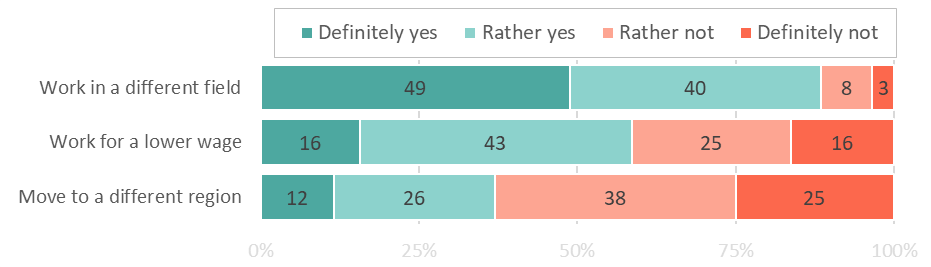
Unemployment is considered a stigmatising life event in the Czech Republic, which is why the May “Trends” survey asked what people would be willing to do to minimise the impact of unemployment if it affected them. The study shows that more than half (59%) of the Czech working-age population would be willing to work for lower wages. The share of people willing to work for lower wages has reached a de facto historical low, as e.g. in May 2020 (i.e. at the beginning of the COVID-19 pandemic), this share was 73%, and during the last economic recession (c. 2008-2014) it oscillated around 80%. The recent enormous price increases are thus most likely limiting the willingness of many people to accept lower wages.
The second option to deal with potential unemployment is to move because of work. The willingness to move to another region for work is generally low in the Czech Republic, with around a third (37%) of respondents considering this option. Another option is to change one’s qualifications or to work in a different field – 89% of people would consider this option. The study thus clearly shows that for most Czechs, changing their profession is more acceptable than moving for work.
What would Czechs be willing to do if they faced unemployment?[3] (in %)
(Population excluding old-age pensioners)
Source: STEM – Trendy 05/2024
What would Czechs be willing to do if they faced unemployment?3
(the share of affirmative answers, population excluding old-age pensioners)
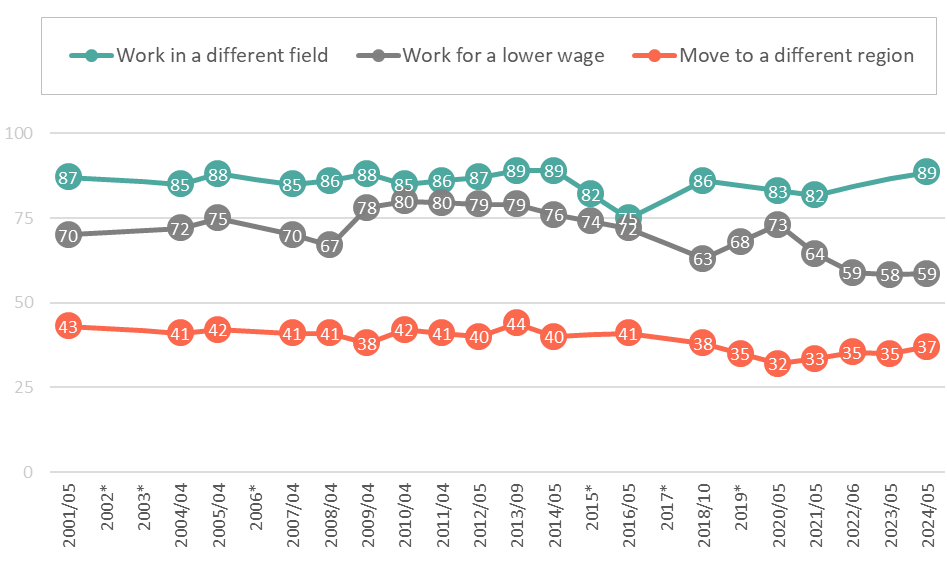
* The question was not included in the marked year.
Source: STEM, Trendy 2001-2024
The cited research of the STEM Research Institute (www.stem.cz) was conducted on a representative sample of the Czech population aged 18 and older on 9-18 May 2024. 1,053 respondents answered the survey in a combination of online and face-to-face interviews (CAWI+CAPI). The report also uses data from earlier runs of the Trendy (“Trends”) regular survey, which are conducted using the same methodology on a sample of more than 1,000 participants. The Trendy research series is funded entirely by STEM and does not depend on sponsorships or partnerships.
______________________________________________________________________________________________________________
[1] See the data of the Czech Statistical Office (CSO/ČSÚ).
[2] See the data of the Czech Ministry of Labour and Social Affairs (MPSV).
[3] Answers to the following questions:
“If you were facing unemployment, would you be willing to work outside your qualifications, outside your field?”
“If your job was threatened, would you be willing to work for less pay just to stay employed?”
“If you were facing unemployment, would you be willing to move to another city, town, or village in another region of our country for an adequate job?”