
STEM has long focused on public attitudes towards climate change and broader environmental issues and topics. To analyze these attitudes, we use a typology that divides the public into five groups[1]:
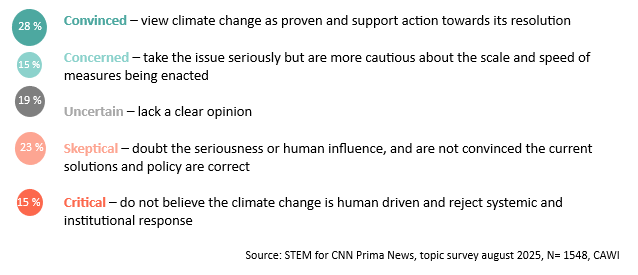
As of August 2025, about 43% of the population belonged to groups emphasizing climate change. More than one-third (38%) expressed skeptical attitudes, while one-fifth remained uncertain. Since 2020, skepticism has gradually risen: the share of the “Convinced” dropped from 34% to 28%, and the “Concerned” from 22% to 15%. In contrast, the skeptical and critical segments have grown. The “Uncertain” group has remained steady at around 17–19%.
„We interpret this trend as a result of growing politicization. Debate has shifted from broad goals to specific policies. A portion of the public rejecting these measures also tends to downplay the problem itself – with lower conviction that climate change is human-driven, or the belief that the issue should be dealt with later,” explains STEM analyst Martin Philipp. Distribution of attitudes varies significantly across the political spectrum. Among Pirate (with Greens) supporters, 58% are “Convinced” and another 12% “Concerned” — together making up 70%. STAN voters are less one-sided, but still lean majority pro-climate, as do SPOLU supporters.
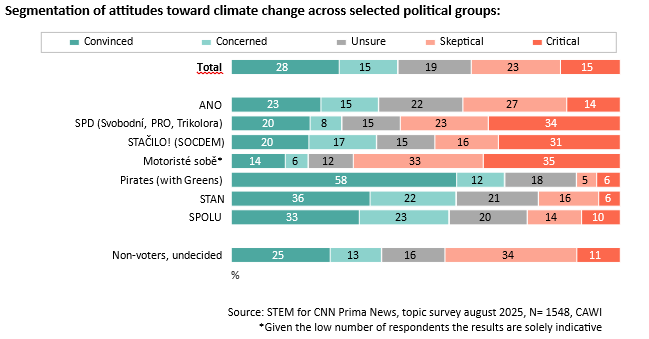
Among ANO supporters, attitudes are more evenly spread. Pro-climate groups make up 38% — slightly below the national average — while only 14% are “Critical,” showing no strong polarization. In contrast, STAČILO! (SOCDEM) voters lean more skeptical, with 31% “Critical.”
SPD supporters (together with Svobodní, PRO, and Trikolora) are strongly skeptical: one-third (34%) are “Critical” and 23% are “Skeptical.” Among Motoristé sobě supporters, negative views are even stronger — two-thirds are
The Czech publics‘ knowledge of the currently implemented system of emission allowances ETS2 is still limited. Only 15% declare they have a clear understanding, while 33% have some general awareness. On the other side of the spectrum, there is approximately 29% of those who have never heard of the ETS2 and almost a quarter of the population admits it has vague knowledge of what exactly the ETS2 is.
What Are Emissions Allowances?
The EU ETS is a market-based system in which the European Union sets a declining cap on total emissions and issues a limited number of allowances (1 allowance = the right to emit 1 ton of CO₂). Companies must cover their emissions with allowances. Those that can reduce emissions at lower cost save allowances and sell them, while others must purchase additional ones. Because the total number of allowances decreases every year, overall emissions are reduced as well.
What Is ETS2?
The new ETS2 system covers emissions from fuel use in buildings and road transport. The obligation to purchase allowances falls on fuel suppliers (gas, coal, gasoline, diesel), not directly on households. The costs are passed on to final prices of fossil fuels and heating, which is intended to encourage a faster transition to cleaner heating and transport. Revenues from allowances are returned to small businesses and households in the form of subsidies and contributions through the Social Climate Fund.
Source: EU ETS2 – Emissions trading in the buildings, road transport, and other sectors, available here.
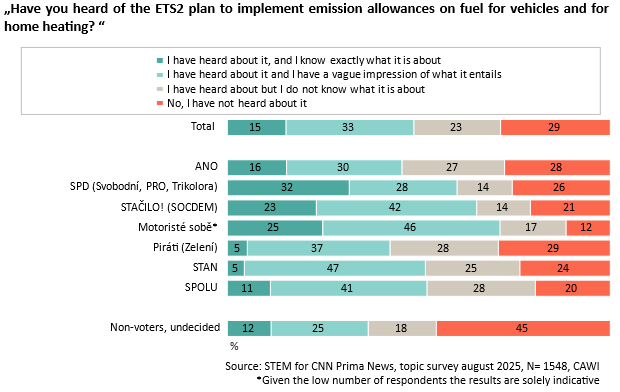
Supporters of STAN and SPOLU show somewhat higher baseline awareness – about half report at least some knowledge, though detailed understanding remains rare. Pirate (with Greens) voters, despite their strong pro-climate orientation, also hover mostly around the basic-awareness level. Paradoxically, those who claim the greatest familiarity with ETS2 are often supporters of parties with skeptical attitudes – Motoristé sobě, SPD, and STAČILO! (SOCDEM). Between one-quarter and one-third of these voters say they are “well-informed.”
“We link this higher awareness to the fact that these parties often highlight ETS2 in their communications, usually in a negative context. This shapes the public debate, so ETS2 in the Czech Republic is framed predominantly critically,” explains STEM analyst Doris Borovcová. “As a result, some voters appear more informed than others, but their knowledge is often based on the critical framing of party campaigns, focusing mostly on price increases — especially fuel prices.”
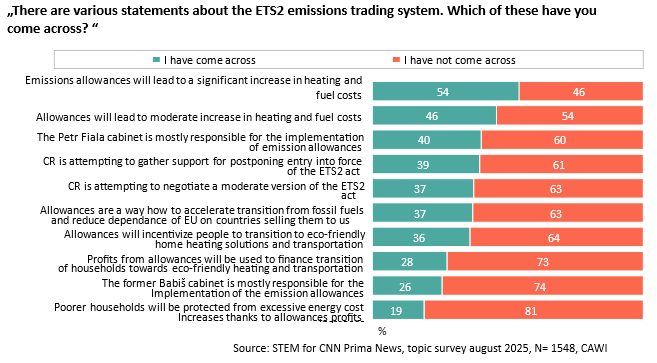
The negative framing of ETS2 reaches the public more often than positive communication. About half of the population has encountered the message that ETS2 will drive up prices. Many also connect ETS2 more with the current government than with the former government of Prime Minister Babiš. In contrast, messages about ecological benefits or economic compensation are much less widespread – only about one-third of the population has heard them. “Only one in five has heard about how ETS2 might affect low-income households, and even then, without clear details,” notes Borovcová.
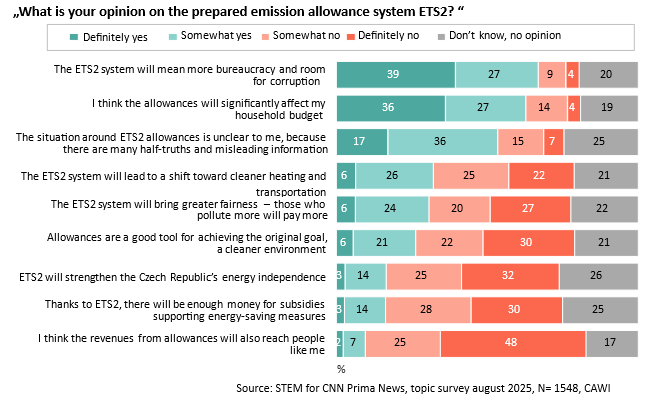
When asked about their opinion of ETS2, about two-thirds of Czechs believe the system will bring more bureaucracy and opportunities for corruption. One in three expects a significant hit to their household budget and most also agree the situation is confusing and unclear. Skepticism about potential benefits is widespread: about one-third believe in ecological improvements, but only weakly; around 17% see potential in energy independence or subsidies for savings; and almost no one expects to personally benefit from ETS2 revenues.
Negative expectations are especially strong among SPD, STAČILO! (SOCDEM), and Motoristé sobě supporters, four out of five of whom fear more bureaucracy or corruption, with similar numbers concerned about household budgets. ANO voters are somewhat less critical, but three in five still expect higher bureaucracy or financial strain.
Supporters of SPOLU and STAN are more open to positive outcomes: about half see potential in cleaner heating and transport, or in applying a fairer “polluter pays” principle. Pirate (with Greens’) voters are the most optimistic, mentioning negative impacts far less frequently. This correlates with the higher share of pro-climate voters in their base. “Nevertheless, confidence in compensation and personal benefit from ETS2 revenues remains low, and across the political spectrum people continue to feel the overall situation is unclear,” concludes Borovcová.
The dataset for the above analysis was generated as part of a survey conducted by STEM for CNN Prima NEWS. The survey took place in August 2025 (three waves in the second half of August) using the CAWI method on a sample of N = 1,548 respondents.
The survey is based on quota sampling to represent the Czech adult population (quota criteria: gender, age, education, region, and size of municipality). Additional attention was given to ensuring the dataset also reflects voting behavior in the 2021 parliamentary elections. The data were weighted by socio-occupational status, past voting behavior in the 2021 parliamentary elections, and in the second round of the 2023 presidential election.
A detailed description of the research methodology is available on STEM’s website here.
[1]Rozděleni klimatem 2021, available from: https://www.irozhlas.cz/zivotni-styl/spolecnost/zmena-klimatu-sucho-migrace-vyzkum-rozdeleni-svobodou-datova-zurnalistika-cesky_2105120534_nkr